How to use this page
Try each problem first, then expand Hint 1, Hint 2, and the Solution only when needed.
Make mistakes now — not on the test! 🎯
Formulas Provided on the Exam
Problems
Problem 1
A manufacturer determines price and cost by
Find the absolute maximum revenue if they can only make 100–200 tables.
A. Revenue < $9,500
B. $9,500 < revenue ≤ $11,000
C. $11,000 < revenue ≤ $12,500
D. $12,500 < revenue ≤ $14,000
E. Revenue ≥ $14,000
Hint 1: Start here
Which quantity must be maximized, and how do price and quantity combine to form that function?
Hint 2: Idea and first steps
You need to maximize revenue, and revenue is price times quantity. Start by writing
\[ R(x)=x(120-0.25x). \]Then find critical points from \(R'(x)=0\), and compare all candidates that lie in \([100,200]\), including endpoints.
Problem 2
Find the number of tables \(x\) the manufacturer should produce to break even.
A. \(100 < x \le 125\)
B. \(125 < x \le 150\)
C. \(150 < x \le 175\)
D. \(175 < x \le 200\)
Hint 1: Start here
At a break-even quantity, what must be true about profit, and therefore about revenue and cost?
Hint 2: Idea and first steps
Break-even means profit is zero, so revenue equals cost. Set
\[ x(120-0.25x)=0.5x^2-375, \]move all terms to one side, and solve the quadratic equation. Keep only quantities that make sense in context.
Problem 3
Let
Classify each critical number as a relative maximum, minimum, or neither.
A. \(-2\) min, \(2\) max, \(0\) neither
B. \(-2\) max, \(2\) min, \(0\) neither
C. \(-2\) max, \(2\) max, \(0\) neither
D. \(-2\) min, \(2\) min, \(0\) neither
E. \(2\) min, \(0\) max
Hint 1: Start here
How can you use the sign of \(f'(x)\) on intervals to decide whether each critical number is a relative maximum, minimum, or neither?
Hint 2: Idea and first steps
First factor \(f'(x)=3x^4-12x^2\) to find the critical numbers. Then build a sign chart for \(f'(x)\) on the intervals between those values and classify each point from the sign changes.
Problem 4
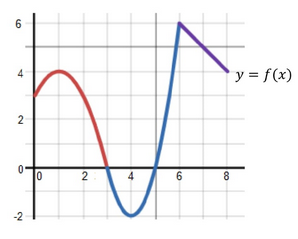
Use left-endpoint Riemann sums with 4 subintervals on \([0,8]\) to estimate the area under \(y=f(x)\). (Use the given graph.)
A. 28
B. 20
C. 22
D. 19
E. 23
Hint 1: Start here
For a left-endpoint Riemann sum, which \(x\)-values determine rectangle heights, and how do you find the common width?
Hint 2: Idea and first steps
Because \([0,8]\) is split into 4 equal pieces, \(\Delta x=(8-0)/4=2\). The left endpoints are \(x=0,2,4,6\), so estimate
\[ L_4=\Delta x\,[f(0)+f(2)+f(4)+f(6)]. \]Problem 5
Demand:
Compute \(E(3)\) and interpret.
A. Elastic at \(p=3\) because \(E(3) > 1\)
B. Inelastic at \(p=3\) because \(E(3) < 1\)
C. Elastic at \(p=3\) because \(E(3) < 1\)
Hint 1: Start here
What pieces do you need at \(p=3\) before you can evaluate elasticity: the quantity \(x\), the derivative \(dx/dp\), or both?
Hint 2: Idea and first steps
You need both values. Compute \(x(3)\) from the demand equation and compute \(\left.\dfrac{dx}{dp}\right|_{p=3}\), then substitute into
\[ E(p)=\frac{p}{x}\left|\frac{dx}{dp}\right|. \]Finally compare your result to 1 to interpret elastic vs. inelastic demand.
Problem 6
Investment A: 3.6% compounded quarterly
Investment B: 3.55% compounded continuously
Compare effective yields.
A. A better by > 0.05%
B. B better by > 0.05%
C. A better by < 0.05%
D. B better by < 0.05%
Hint 1: Start here
Which formula gives effective annual yield for quarterly compounding, and which formula gives it for continuous compounding?
Hint 2: Idea and first steps
For Investment A use
\[ \left(1+\frac{0.036}{4}\right)^4-1, \]and for Investment B use
\[ e^{0.0355}-1. \]Convert both to percentages and then compare their difference to \(0.05\%\).
Problem 7
Marginal cost:
Fixed cost = $7000.
Find \(C(100)\).
A. < $20,000
B. $20,000 ≤ \(C(100)\) ≤ $22,000
C. $22,000 ≤ \(C(100)\) ≤ $24,000
D. $24,000 ≤ \(C(100)\) ≤ $26,000
E. > $26,000
Hint 1: Start here
How do marginal cost and total cost relate, and what extra information is needed after integrating?
Hint 2: Idea and first steps
Integrate \(C'(x)\) term by term to get a general cost function \(C(x)+K\), then use the fixed-cost condition \(C(0)=7000\) to determine the constant and evaluate at \(x=100\).
Problem 8
Find the area under \(f(x)=-e^{-x}\) from \(x=0\) to \(x=1\). Leave answer in terms of \(e\).
A. \(-e^{-1} + 1\)
B. \(e^{-1} - 1\)
C. \(e^{-1} + 1\)
D. \(e^{-1} - 1\)
Hint 1: Start here
Does the problem ask for signed net change or geometric area, and how does that affect the sign of your final result?
Hint 2: Idea and first steps
Start with the definite integral
\[ \int_0^1 -e^{-x}\,dx, \]using antiderivative \(e^{-x}\). Because the curve is below the \(x\)-axis on this interval, take the absolute value at the end to report area.
Problem 9
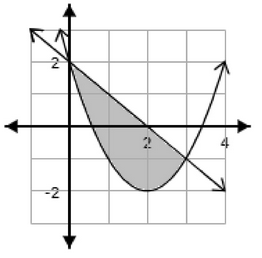
Area between
on \([0,3]\).
A. \(\int_0^3 (x^2 - 5x + 4)\,dx\)
B. \(\int_0^3 (x^2 - 3x + 4)\,dx\)
C. \(\int_0^3 (x^2 - 3x)\,dx\)
D. \(\int_0^3 (-x^2 + 3x)\,dx\)
E. \(\int_0^3 (x^2 + 3x)\,dx\)
Hint 1: Start here
For area between two curves on an interval, what integrand should you build from the two functions?
Hint 2: Idea and first steps
Area is
\[ \int_a^b(\text{top}-\text{bottom})\,dx. \]Use a test point in \([0,3]\) to decide which function is on top, then simplify \(g(x)-f(x)\) before matching the choice.
Problem 10
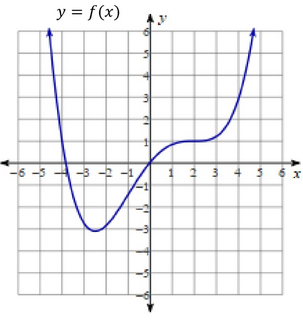
Using the given graph of \(y=f(x)\), order:
\(f'(-4), f'(-3), f'(2), m, f'(0), f'(4)\)
where \(m\) is the slope of the secant line from \(x=-4\) to \(x=4\).
A–E: options printed on original exam.
Hint 1: Start here
What does each derivative value represent on the graph, and how can you compare them by slope direction and steepness?
Hint 2: Idea and first steps
At each marked \(x\)-value, sketch or imagine the tangent line. Rank slopes from most negative to most positive by first deciding sign (downward, flat, upward) and then comparing steepness.
Problem 11
A farmer plants 30 grapefruit trees per acre with yield 480 lb/tree.
Each extra tree reduces yield by 12 lb.
Use calculus to maximize yield.
Hint 1: Start here
What is the quantity being maximized, and how can you write both factors in terms of one variable?
Hint 2: Idea and first steps
Let \(x\) be the number of extra trees beyond 30. Then total yield is number of trees times yield per tree:
\[ Y(x) = (30+x)(480 - 12x). \]Differentiate \(Y\), solve \(Y'(x)=0\), and then convert back from extra trees to total trees per acre.
| Problem | Answer |
|---|---|
| 1 | D |
| 2 | C |
| 3 | B |
| 4 | B |
| 5 | B |
| 6 | C |
| 7 | E |
| 8 | A |
| 9 | D |
| 10 | B |
| 11 | see below |
Detailed Solutions
Solution to Problem 1
Step 1: Revenue function
Price:
\[ p = 120 - 0.25x. \]Revenue = (price)·(quantity):
\[ R(x) = x \cdot p = x(120 - 0.25x). \]Distribute the \(x\):
\[ R(x) = 120x - 0.25x^2. \]We want the maximum of \(R(x)\) on \(100 \le x \le 200\).
Step 2: Find critical point
Derivative:
\[ R'(x) = \frac{d}{dx}(120x) - \frac{d}{dx}(0.25x^2) = 120 - 0.5x. \]Set the derivative equal to zero:
\[ 120 - 0.5x = 0. \]Add \(0.5x\) to both sides:
\[ 120 = 0.5x. \]Divide both sides by \(0.5\):
\[ x = \frac{120}{0.5} = 240. \]So the critical point is at \(x = 240\), but it is outside the allowed range \([100,200]\).
Step 3: Evaluate endpoints
Because the critical point is outside the interval, the maximum must occur at one of the endpoints.
At \(x=100\):
\[ R(100) = 120(100) - 0.25(100)^2 = 12000 - 0.25(10{,}000) = 12000 - 2500 = 9500. \]At \(x=200\):
\[ R(200) = 120(200) - 0.25(200)^2 = 24000 - 0.25(40{,}000) = 24000 - 10{,}000 = 14{,}000. \]
So the absolute maximum revenue on \([100,200]\) is \(\boxed{\$14{,}000}\).
This falls into answer choice D.
Solution to Problem 2
We want the break-even point, where
\[ \text{revenue} = \text{cost}. \]From Problem 1:
\[ \text{Revenue} = R(x) = 120x - 0.25x^2, \qquad \text{Cost} = C(x) = 0.5x^2 - 375. \]Set them equal:
\[ 120x - 0.25x^2 = 0.5x^2 - 375. \]Step 1: Move everything to one side
Add \(0.25x^2\) to both sides and add 375 to both sides:
\[ 120x = 0.5x^2 + 0.25x^2 - 375 = 0.75x^2 - 375. \]Now subtract \(120x\) from both sides:
\[ 0 = 0.75x^2 - 120x - 375. \]It is easier without decimals. Note that \(0.75 = \frac{3}{4}\). Multiply the entire equation by 4:
\[ 0 = 3x^2 - 480x - 1500. \]So we solve
\[ 3x^2 - 480x - 1500 = 0. \]Step 2: Quadratic formula
For \(ax^2+bx+c=0\), here \(a=3, b=-480, c=-1500\).
\[ x = \frac{-b \pm \sqrt{b^2 - 4ac}}{2a} = \frac{480 \pm \sqrt{(-480)^2 - 4(3)(-1500)}}{2\cdot 3}. \]Compute inside the square root:
- \( (-480)^2 = 230{,}400\),
- \( 4ac = 4\cdot 3 \cdot (-1500) = 12\cdot (-1500) = -18{,}000\).
So
\[ b^2 - 4ac = 230{,}400 - (-18{,}000) = 230{,}400 + 18{,}000 = 248{,}400. \]Thus
\[ x = \frac{480 \pm \sqrt{248{,}400}}{6}. \]\(\sqrt{248{,}400}\) is approximately \(498.4\).
So the two solutions are approximately:
\[ x_1 \approx \frac{480 + 498.4}{6} = \frac{978.4}{6} \approx 163.1, \]\[ x_2 \approx \frac{480 - 498.4}{6} = \frac{-18.4}{6} \approx -3.1. \]The negative solution does not make sense for a number of tables, so we keep
\[ x \approx 163. \]This is in the interval \(150 < x \le 175\), so the correct answer is C.
Solution to Problem 3
We are given:
\[ f'(x) = 3x^4 - 12x^2. \]Step 1: Factor the derivative
Factor out the greatest common factor \(3x^2\):
\[ f'(x) = 3x^2(x^2 - 4). \]Now factor the difference of squares:
\[ x^2 - 4 = (x-2)(x+2), \]so
\[ f'(x) = 3x^2(x-2)(x+2). \]Step 2: Critical numbers
Critical numbers occur when \(f'(x) = 0\):
\[ 3x^2(x-2)(x+2) = 0. \]This happens when
\[ x^2 = 0 \quad \text{or} \quad x-2=0 \quad \text{or} \quad x+2=0, \]so
\[ x = 0,\quad x=2,\quad x=-2. \]Step 3: Sign chart for \(f'(x)\)
We examine intervals:
- \((-\infty,-2)\)
- \((-2,0)\)
- \((0,2)\)
- \((2,\infty)\)
Pick test values:
For \(x=-3\) (in \((-\infty,-2)\))
- \(x^2 > 0\),
- \(x-2\) is negative,
- \(x+2\) is negative.
So the sign of \(f'(x)\) is
\[ (+)\cdot(-)\cdot(-) = (+), \]which means \(f'(x) > 0\) and \(f\) is increasing.
For \(x=-1\) (in \((-2,0)\))
- \(x^2>0\),
- \(x-2\) is negative,
- \(x+2\) is positive.
Signs: \((+)\cdot(-)\cdot(+) = (-)\).
So \(f'(x) < 0\) and \(f\) is decreasing.For \(x=1\) (in \((0,2)\))
The signs are the same as for \(-1\), so \(f'(x) < 0\) and \(f\) is still decreasing.For \(x=3\) (in \((2,\infty)\))
- \(x^2>0\),
- \(x-2\) is positive,
- \(x+2\) is positive.
Signs: \((+)\cdot(+)\cdot(+)=(+)\).
So \(f'(x) > 0\) and \(f\) is increasing.
Step 4: Classification
Look at how \(f\) changes around each critical point:
At \(x=-2\):
To the left, \(f'(x) > 0\) (increasing).
To the right, \(f'(x) < 0\) (decreasing).
Increasing followed by decreasing means a relative maximum at \(x=-2\).At \(x=0\):
\(f'(x) < 0\) on both sides (decreasing on left and right).
Decreasing on both sides means \(x=0\) is neither a max nor a min.At \(x=2\):
To the left, \(f'(x) < 0\) (decreasing).
To the right, \(f'(x) > 0\) (increasing).
Decreasing followed by increasing means a relative minimum at \(x=2\).
This matches answer choice B.
Solution to Problem 4
We divide \([0,8]\) into 4 equal subintervals.
Step 1: Width \(\Delta x\)
\[ \Delta x = \frac{8-0}{4} = 2. \]Left endpoints: \(x=0, 2, 4, 6\).
Step 2: Riemann sum formula
Left Riemann sum:
\[ \text{Area} \approx \sum_{i=1}^4 f(x_{i-1})\Delta x = 2\,[f(0) + f(2) + f(4) + f(6)]. \]From the graph (on the exam), you read approximate heights \(f(0), f(2), f(4), f(6)\)
So
\[ \text{Area} = 2\,[3+3-2+6] = 2\cdot 10 = 20. \]Answer: B.
Solution to Problem 5
Demand:
\[ x = 16 - \frac{1}{3}p^2. \]Step 1: Compute \(x\) and \(\dfrac{dx}{dp}\)
Differentiate with respect to \(p\):
\[ \frac{dx}{dp} = 0 - \frac{1}{3}\cdot 2p = -\frac{2p}{3}. \]At \(p=3\):
\[ x = 16 - \frac{1}{3}(3^2) = 16 - \frac{1}{3}\cdot 9 = 16 - 3 = 13, \]and
\[ \left.\frac{dx}{dp}\right|_{p=3} = -\frac{2(3)}{3} = -2. \]Step 2: Elasticity formula
\[ E(p) = \frac{p}{x}\left|\frac{dx}{dp}\right|. \]So
\[ E(3) = \frac{3}{13}\cdot | -2 | = \frac{3}{13}\cdot 2 = \frac{6}{13} \approx 0.4615. \]Because \(E(3) < 1\), demand is inelastic at price $3.
Answer: B.
Solution to Problem 6
We compare effective annual yields.
Step 1: Investment A (3.6% quarterly)
Nominal rate \(r_A = 0.036\), compounded \(n=4\) times per year.
Effective rate:
\[ \text{Eff}_A = \left(1 + \frac{r_A}{n}\right)^n - 1 = \left(1 + \frac{0.036}{4}\right)^4 - 1 = (1 + 0.009)^4 - 1. \]Compute:
\[ (1.009)^2 \approx 1.018081, \]\[ (1.018081)^2 \approx 1.03645. \]Thus
\[ \text{Eff}_A \approx 1.03645 - 1 = 0.03645 = 3.645\%. \]Step 2: Investment B (3.55% continuous)
Nominal rate \(r_B = 0.0355\).
Effective rate:
\[ \text{Eff}_B = e^{r_B} - 1 = e^{0.0355} - 1. \]Using a calculator,
\[ e^{0.0355} \approx 1.03615. \]So
\[ \text{Eff}_B \approx 1.03615 - 1 = 0.03615 = 3.615\%. \]Step 3: Compare
Difference:
\[ \text{Eff}_A - \text{Eff}_B \approx 0.03645 - 0.03615 = 0.00030 = 0.03\%. \]Investment A has the better yield, but only by 0.03%, which is less than 0.05%.
Answer: C.
Solution to Problem 7
We are given the marginal cost:
\[ C'(x) = 0.000009x^2 - 0.08x + 200, \]and fixed cost \(C(0)=7000\).
We want \(C(100)\).
Step 1: Integrate to find \(C(x)\)
Integrate term by term:
\(\displaystyle \int 0.000009x^2\,dx = 0.000009 \cdot \frac{x^3}{3} = 0.000003x^3.\)
\(\displaystyle \int (-0.08x)\,dx = -0.08 \cdot \frac{x^2}{2} = -0.04x^2.\)
\(\displaystyle \int 200\,dx = 200x.\)
So
\[ C(x) = 0.000003x^3 - 0.04x^2 + 200x + K. \]Step 2: Use fixed cost to find \(K\)
Using \(C(0)=7000\):
\[ C(0) = 0.000003(0)^3 - 0.04(0)^2 + 200(0) + K = K, \]so
\[ K = 7000. \]Thus
\[ C(x) = 0.000003x^3 - 0.04x^2 + 200x + 7000. \]Step 3: Evaluate at \(x=100\)
Compute each term:
\(0.000003x^3\) with \(x=100\):
\(100^3 = 1{,}000{,}000\), so
\[ 0.000003 \cdot 1{,}000{,}000 = 3. \]\(-0.04x^2\) with \(x=100\):
\(100^2 = 10{,}000\), so
\[ -0.04 \cdot 10{,}000 = -400. \]\(200x\) with \(x=100\):
\[ 200\cdot 100 = 20{,}000. \]
Now sum:
\[ C(100) = 3 - 400 + 20{,}000 + 7{,}000 = (3 - 400) + 27{,}000 = -397 + 27{,}000 = 26{,}603. \]So \(C(100) = \$26{,}603\).
This is greater than \(\$26,000\), so the correct choice is E.
Solution to Problem 8
We want the area bounded by the curve \(y=-e^{-x}\) and the \(x\)-axis from \(x=0\) to \(x=1\).
Note: the curve lies below the \(x\)-axis (since \(-e^{-x} < 0\)), but area is positive.
Step 1: Compute the definite integral
The signed area (integral of the function) is
\[ \int_0^1 -e^{-x}\,dx. \]Antiderivative:
\[ \int -e^{-x}dx = e^{-x} + C \](since derivative of \(e^{-x}\) is \(-e^{-x}\)).
Evaluate from 0 to 1:
\[ \int_0^1 -e^{-x}dx = \left[e^{-x}\right]_0^1 = e^{-1} - e^{0} = e^{-1} - 1. \]This value is negative (because \(e^{-1}<1\)).
Step 2: Turn signed area into geometric area
Area between the curve and the x-axis is the absolute value:
\[ \text{Area} = \left|\int_0^1 -e^{-x}dx\right| = |e^{-1} - 1| = 1 - e^{-1}. \]This equals \(-e^{-1}+1\) (just reversing the order of subtraction).
So the correct expression is
\[ 1-e^{-1} = -e^{-1}+1, \]which is answer A.
Solution to Problem 9
We have
\[ f(x) = x^2 - 4x + 2,\qquad g(x) = -x + 2. \]We want the area between them from \(x=0\) to \(x=3\).
Step 1: Decide which function is on top
Evaluate at a convenient point, say \(x=1\):
- \(f(1) = 1^2 - 4(1) + 2 = 1 - 4 + 2 = -1\).
- \(g(1) = -1 + 2 = 1\).
So at \(x=1\), \(g(x)\) is above \(f(x)\).
The graph on the exam also shows \(g\) above \(f\) on \([0,3]\).
Thus the top function is \(g(x)\) and the bottom function is \(f(x)\).
Step 2: Set up area integral
\[ \text{Area} = \int_0^3 [\text{top} - \text{bottom}]\,dx = \int_0^3 [g(x) - f(x)]\,dx. \]Compute \(g(x) - f(x)\):
\[ g(x) - f(x) = (-x + 2) - (x^2 - 4x + 2). \]Distribute the minus sign carefully:
\[ g(x) - f(x) = -x + 2 - x^2 + 4x - 2 = -x^2 + (-x + 4x) + (2 - 2) = -x^2 + 3x. \]So algebraically the integrand is \(-x^2 + 3x\), so the correct setup is
\[ ext{Area} = \int_0^3 (-x^2 + 3x)\,dx, \]which matches choice D.
Solution to Problem 10
Here we reason from the graph. Choose an \(x\)-value, mark the point \((x,f(x))\), and sketch the tangent line at that point. Then compare the steepness (slopes) of those tangent lines.
- \(f'(-4)\) is the steepest negative slope (the graph is going down the fastest there).
- \(f'(-3)\) is negative but near a local minimum, so it is a small negative slope.
- \(f'(2)\) is zero slope (the graph has a horizontal tangent there).
- \(f'(0)\) is a small positive slope (the graph is going up slowly there).
- \(f'(4)\) is the largest positive slope.
So ordering the derivatives, we have:
\[f'(-4) < f'(-3) < f'(2) < f'(0) < f'(4).\]Solution to Problem 11
We model total yield (pounds per acre).
Let \(x\) be the number of extra trees per acre, beyond 30.
Then:
- Number of trees: \(30+x\).
- Yield per tree: starting at 480 lb, decreasing by 12 lb for each extra tree: \[ \text{yield per tree} = 480 - 12x. \]
Step 1: Total yield function
\[ Y(x) = (\text{number of trees})\cdot(\text{yield per tree}) = (30 + x)(480 - 12x). \]Expand:
First multiply \(30\) by each term:
\[ 30(480 - 12x) = 30\cdot 480 - 30\cdot 12x = 14{,}400 - 360x. \]Then multiply \(x\) by each term:
\[ x(480 - 12x) = 480x - 12x^2. \]Add them:
\[ Y(x) = (14{,}400 - 360x) + (480x - 12x^2) = 14{,}400 + (-360x + 480x) - 12x^2 = 14{,}400 + 120x - 12x^2. \]So
\[ Y(x) = -12x^2 + 120x + 14{,}400. \]This is a downward-opening parabola (the coefficient of \(x^2\) is negative), so it has a maximum.
Step 2: Take derivative and find critical point
\[ Y'(x) = \frac{d}{dx}(-12x^2 + 120x + 14{,}400) = -24x + 120. \]Set the derivative equal to zero:
\[ -24x + 120 = 0. \]Subtract 120 from both sides:
\[ -24x = -120. \]Divide by \(-24\):
\[ x = \frac{-120}{-24} = 5. \]So the critical point is at \(x=5\).
Step 3: Confirm maximum
Second derivative:
\[ Y''(x) = \frac{d}{dx}(-24x + 120) = -24. \]Since \(Y''(x) = -24 < 0\), the graph is concave down, so \(x=5\) gives a maximum.
Step 4: Interpret in terms of trees
Recall: \(x\) is the number of extra trees beyond 30.
So the optimal number of trees is:
\[ 30 + x = 30 + 5 = 35. \]Thus, to maximize total yield, the farmer should plant 35 trees per acre.