How to use the hints
Each problem has two hints that do different jobs.
- Hint 1 asks the strategic question: what idea, formula, or interpretation should you use?
- Hint 2 answers that question and helps you start the setup or first calculation step.
Try to name the quantity being found and its units before you compute.
Basic rules
Constant rule
\[ \frac{d}{dx}[k] = 0 \]Power rule
\[ \frac{d}{dx}[x^n] = n x^{n-1} \quad (\text{for any real } n) \]Constant multiple rule
\[ \frac{d}{dx}[k\,f(x)] = k\,f'(x) \]Sum & difference rules
\[ \frac{d}{dx}[f(x) \pm g(x)] = f'(x) \pm g'(x) \]
Product & quotient rules
Product rule – for \(h(x)=f(x)\,g(x)\):
\[ h'(x) = f'(x)\,g(x) + f(x)\,g'(x) \]Quotient rule – for \(h(x)=\dfrac{f(x)}{g(x)}\):
\[ h'(x) = \frac{f'(x)\,g(x) - f(x)\,g'(x)}{[g(x)]^{2}} \]
Chain rule
If \(h(x) = f(g(x))\) (a composition), then
\[ h'(x) = f'(g(x))\cdot g'(x). \]Problems
Problem 1
The demand (price) function for a product is
\[ p(x) = 800 - 0.2x, \]where \(x\) is the number of units sold and \(p(x)\) is the price per unit (in dollars).
The revenue function is \(R(x) = x\,p(x)\).
Find the marginal revenue when \(1600\) units are sold, i.e.\ find \(R'(1600)\).
Choices
(A) more than $155 per unit
(B) between $145 and $155 per unit
(C) between $135 and $145 per unit
(D) between $125 and $135 per unit
(E) less than $125 per unit
Hint 1: Start here
What quantity is being asked for here: total revenue or marginal revenue, and which function must be differentiated before evaluating at \(x=1600\)?
Hint 2: Idea and first steps
- First write \(R(x)\) explicitly: \[ R(x) = x(800-0.2x). \]
- Either expand and use the power rule, or apply the product rule directly.
- After finding \(R'(x)\), plug in \(x=1600\).
Keep track of units: revenue is in dollars per unit of \(x\).
Problem 2
The quantity demanded \(q\) (number of units sold) depends on price \(p\) via
\[ q(p) = 7900 - 3p^{2}, \]where \(p\) is the price in dollars.
When the price per unit is $30, the elasticity of demand is
\[ E(p) = -\frac{p}{q(p)}\,\frac{dq}{dp}. \]At \(p=30\) the elasticity is:
Choices
(A) less than \(0.8\)
(B) between \(0.8\) and \(1.0\)
(C) between \(1.0\) and \(1.2\)
(D) between \(1.2\) and \(1.4\)
(E) more than \(1.4\)
Hint 1: Start here
Before you can compute \(E(30)\), which values do you need at \(p=30\): \(q(30)\), \(q'(30)\), or both?
Hint 2: Idea and first steps
- Compute \(q(30)\).
- Compute \(q'(30)\).
- Then calculate \[ E(30) = -\frac{30}{q(30)}\cdot q'(30) \] and approximate as a decimal.
- Compare your value to the intervals in the choices.
Problem 3
Let
\[ j(x)=x^{2} f(x), \]where \(f(x)\) is differentiable.
Suppose \(f(3) = -2\) and \(f'(3) = 5\).
Find \(j'(3)\).
Choices
(A) \(-3\)
(B) \(0\)
(C) \(3\)
(D) \(33\)
(E) None of these
Hint 1: Start here
In \(j(x)=x^2f(x)\), what derivative rule handles multiplying two functions together?
Hint 2: Idea and first steps
The product rule says:
\[ j'(x) = (x^{2})' f(x) + x^{2} f'(x). \]- Compute \((x^{2})'\).
- Plug in \(x=3\), \(f(3)=-2\), and \(f'(3)=5\).
Problem 4
Suppose \(f\) and \(g\) are differentiable functions such that
\[ f(2) = 6,\quad f'(2) = 7,\quad g(2) = 5,\quad g'(2) = -4. \]Let
\[ h(x) = \frac{f(x)}{g(x)}. \]Find \(h'(2)\).
Choices
(A) \(-\dfrac{7}{4}\)
(B) \(\dfrac{59}{25}\)
(C) \(\dfrac{6}{5}\)
(D) \(-\dfrac{59}{25}\)
(E) None of these
Hint 1: Start here
Since \(h(x)=\dfrac{f(x)}{g(x)}\), which derivative rule should you use to find \(h'(2)\)?
Hint 2: Idea and first steps
Quotient rule:
\[ h'(x) = \frac{f'(x)\,g(x) - f(x)\,g'(x)}{[g(x)]^{2}}. \]- Plug in \(x=2\).
- Carefully substitute the four given values: \(f(2), f'(2), g(2), g'(2)\).
- Simplify the fraction.
Problem 5
Let \(C(x)\) represent the cost, in dollars, to produce \(x\) water bottles.
Assume \(C'(x)\) is the marginal cost function.
Which of the following is the best interpretation of
\[ C'(8) = 20 ? \]Choices
(A) It costs approximately $20 to produce the 9th water bottle.
(B) It costs approximately $8 to produce the 21st water bottle.
(C) It costs $20 to produce 8 water bottles.
(D) It costs $8 to produce 20 water bottles.
(E) It costs $2.50 to produce each water bottle.
Hint 1: Start here
Does \(C'(8)=20\) describe a total cost, or a rate at which cost is changing near 8 bottles, and what are the units?
Hint 2: Idea and first steps
Think: When \(x=8\) bottles, what does “\(C'(8) = 20\)” say about how total cost changes if we increase production slightly?
Your response should mention “approximately” and talk about the next bottle (or next few bottles).
Problem 6
Let
\[ g(x) = \sqrt{-5x^{2} + 7x}. \]Find \(g'(x)\). (Assume the inside of the square root is positive on the domain we care about.)
Choices
(A) \(\displaystyle \frac{-10x + 7}{2\sqrt{-5x^{2}+7x}}\)
(B) \(\displaystyle \frac{-10x - 7}{2\sqrt{-5x^{2}+7x}}\)
(C) \(\displaystyle \frac{-10x + 7}{\sqrt{-5x^{2}+7x}}\)
(D) \(\displaystyle \frac{10x - 7}{2\sqrt{-5x^{2}+7x}}\)
(E) \(\displaystyle \frac{7 - 5x^{2}}{2\sqrt{-5x^{2}+7x}}\)
Hint 1: Start here
If \(g(x)=\sqrt{-5x^2+7x}\), what are the outer and inner functions, and which derivative rule connects them?
Hint 2: Idea and first steps
Write
\[ g(x) = (-5x^{2}+7x)^{1/2}. \]- Outside function: \(f(u)=u^{1/2}\).
- Inside function: \(u(x) = -5x^{2}+7x\).
Use
\[ g'(x)=f'(u(x))\cdot u'(x). \]Compute both \(f'(u)\) and \(u'(x)\).
Problem 7
Suppose the elasticity of demand \(E(p)\) for a certain demand function at a price level satisfies
\[ E(p) = 0.84. \]Which statement correctly describes what happens to revenue when price increases slightly?
Choices
(A) The demand is elastic, so as price increases, revenue decreases.
(B) The demand is elastic, so as price increases, revenue increases.
(C) The demand is inelastic, so as price increases, revenue decreases.
(D) The demand is inelastic, so as price increases, revenue increases.
Hint 1: Start here
Given \(E(p)=0.84\), is demand elastic or inelastic, and what does that predict about revenue when price increases slightly?
Hint 2: Idea and first steps
Here \(E(p) = 0.84\).
- Decide if that is elastic or inelastic.
- Recall:
- With elastic demand, increasing price makes revenue go down.
- With inelastic demand, increasing price makes revenue go up.
Problem 8
Suppose \(f\) is a differentiable function whose derivative is
\[ f'(x) = 2x^{2} + 6x - 20. \]Find the locations of all relative extrema of \(f\), and say whether each point is a relative maximum or a relative minimum.
Choices
(A) A relative maximum occurs at \(x=-5\).
A relative minimum occurs at \(x=2\).
(B) A relative maximum occurs at \(x=2\).
A relative minimum occurs at \(x=-5\).
(C) A relative maximum occurs at \(x=1.5\).
(D) A relative minimum occurs at \(x=1.5\).
(E) \(f(x)\) does not have any relative extrema.
Hint 1: Start here
Where can relative extrema occur, and what must you analyze after solving \(f'(x)=0\)?
Hint 2: Idea and first steps
- Factor or use the quadratic formula to solve \[ 2x^{2} + 6x - 20 = 0. \]
- For each critical number, pick test values on the left and right to see whether \(f'\) changes from + to − (max) or − to + (min).
Problem 9
The revenue and cost functions (in dollars) for a video game manufacturer are:
\[ R(x) = 7.51x^{2} - 0.0009x^{3},\\ C(x) = 2.02x^{2} - 0.0003x^{3}, \]where \(x\) is the number of games sold.
The profit function is \(P(x) = R(x) - C(x)\).
Determine the interval of \(x\) on which the profit function \(P(x)\) is increasing.
Choices
(A) \((0,9150)\)
(B) \((0,6100)\)
(C) \((6100,9150)\)
(D) \((0,3050)\)
(E) \((0,\infty)\)
Hint 1: Start here
To find where profit is increasing, should you study \(P(x)\) itself, \(P'(x)\), or both?
Hint 2: Idea and first steps
- Subtract \(C(x)\) from \(R(x)\) to form \(P(x)\) and simplify.
- Differentiate the resulting polynomial.
- Factor \(P'(x)\) and find critical points.
- Use a sign chart to find which intervals make \(P'(x)>0\).
Problem 10
The graph below shows \(y = f'(x)\), the derivative of some function \(f(x)\).
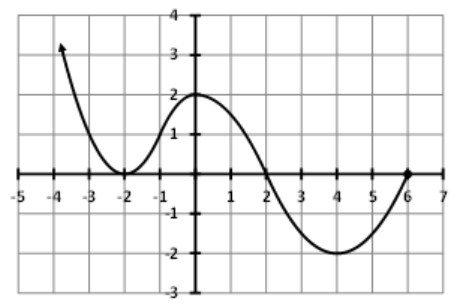
Assuming this is the graph of \(f'(x)\), determine the interval(s) where \(f'(x) < 0\).
Choices
(A) \((-\infty,\infty)\)
(B) \((2,6)\)
(C) \((-2,0)\cup(4,6)\)
(D) \((-\infty,-2)\cup(0,4)\)
(E) \((-\infty,2)\)
Hint 1: Start here
Because the picture is the graph of \(f'(x)\), what visual feature tells you exactly where \(f'(x)<0\)?
Hint 2: Idea and first steps
- Identify the x-values where the graph of \(f'(x)\) crosses the x-axis.
- Check visually which regions are below the x-axis.
- Express that region as an open interval (or union of intervals).
(From the original test, the negative region is approximately from \(x=2\) to \(x=6\).)
Problem 11
Find the critical number(s) of the function
\[ g(x) = x^{3} - 6x^{2}. \]Remember: critical numbers occur where \(g'(x)=0\) or where \(g'(x)\) does not exist.
Choices
(A) \(x=0\) and \(x=6\)
(B) \(x=0\)
(C) \(x=0\) and \(x=4\)
(D) \(x=6\)
(E) \(x=4\)
Hint 1: Start here
What condition defines a critical number, and how does that condition apply to \(g(x)=x^3-6x^2\)?
Hint 2: Idea and first steps
- Differentiate: \[ g'(x) = (x^{3})' - 6(x^{2})'. \]
- Factor out common terms in \(g'(x)\).
- Use the zero product property to find the critical numbers.
Problem 12
Let
\[ f(x) = 2x^{3} - 9x^{2} - 86. \]- Find \(f'(x)\).
- Find the equation of the tangent line to \(f(x)\) at \(x=1\).
- Using the First Derivative Test, determine the interval(s) where:
- (i) \(f(x)\) is increasing,
- (ii) \(f(x)\) is decreasing.
Hint 1: Start here
For the three tasks in this problem, what does each require first: a derivative formula, tangent-line ingredients, or a sign analysis of \(f'(x)\)?
Hint 2: Idea and first steps
- Differentiate \(2x^{3} - 9x^{2} - 86\).
- Evaluate both \(f(1)\) and \(f'(1)\).
- For increasing/decreasing:
- Solve \(f'(x) = 0\) to get critical numbers.
- Create a sign chart for \(f'(x)\).
- Positive derivative ⇒ increasing; negative derivative ⇒ decreasing.
Problem 13
Find the derivatives of the following functions. Your answers do not need to be simplified.
(a)
\[ f(x) = \frac{3}{x^{2}} - 4\sqrt{x}. \](b)
\[ g(x) = \bigl(-x^{3} + 7x^{2} - 3\bigr)^{7}. \](c)
\[ h(x) = (5x^{2} + 3)(4x + 2). \]Hint 1: Start here
For each part \((a),(b),(c)\), which derivative rule should you choose before computing anything?
Hint 2: Idea and first steps
(a) Rewrite:
\[ f(x) = 3x^{-2} - 4x^{1/2}. \](b) For
\[ g(x) = [u(x)]^{7},\quad u(x) = -x^{3} + 7x^{2} - 3, \]use
\[ g'(x) = 7[u(x)]^{6}\cdot u'(x). \](c) Let
\[ f_1(x) = 5x^{2} + 3,\quad f_2(x) = 4x + 2, \]then
\[ h'(x) = f_1'(x) f_2(x) + f_1(x) f_2'(x). \]Problem 14
Consider a cost function
\[ C(x) = \frac{8x + 3}{5x + 7}, \]where the cost is measured in thousands of dollars and \(x\) is the number of units produced (assume \(x>0\)).
Find the marginal cost when \(20\) units are produced. Round your answer to two decimal places and give appropriate units.
Hint 1: Start here
If marginal cost means \(C'(x)\), what must you compute first for this quotient cost function before evaluating at 20 units?
Hint 2: Idea and first steps
Let
\[ f(x) = 8x+3,\quad g(x) = 5x+7,\quad C(x)=\frac{f(x)}{g(x)}. \]Then
\[ C'(x) = \frac{f'(x)g(x) - f(x)g'(x)}{[g(x)]^{2}}. \]After finding \(C'(x)\), evaluate at \(x=20\) and remember that the cost is in thousands of dollars, so the derivative will be in thousands of dollars per unit.
Solutions
Below are the fully worked solutions.
Try to answer the problems using only the hints first; then open the corresponding solution.
Solution 1 (Problem 1)
We are given
\[ p(x) = 800 - 0.2x, \]and the revenue function
\[ R(x) = x\,p(x) = x(800 - 0.2x). \]First expand:
\[ R(x) = 800x - 0.2x^{2}. \]Now differentiate term–by–term:
\[ R'(x) = 800 - 0.4x. \]Now evaluate at \(x=1600\):
\[ R'(1600) = 800 - 0.4(1600) = 800 - 640 = 160. \]So the marginal revenue at 1600 units is $160 per unit, which is more than $155.
Correct choice: (A).
Solution 2 (Problem 2)
We have
\[ q(p) = 7900 - 3p^{2}. \]Step 1: Compute \(q'(p)\)
\[ q'(p) = -6p. \]Step 2: Evaluate at \(p=30\)
\[ q(30) = 7900 - 3(30)^{2} = 7900 - 2700 = 5200, \]\[ q'(30) = -6(30) = -180. \]Step 3: Elasticity
Elasticity of demand:
\[ E(p) = -\frac{p}{q(p)}\,q'(p). \]At \(p=30\):
\[ E(30) = -\frac{30}{5200}(-180) = \frac{30\cdot 180}{5200} = \frac{5400}{5200} \approx 1.0385. \]So \(E(30)\) is between \(1.0\) and \(1.2\).
Correct choice: (C).
Solution 3 (Problem 3)
We are given
\[ j(x) = x^{2} f(x), \]with \(f(3) = -2\) and \(f'(3) = 5\).
Use the product rule with
\[ a(x) = x^{2}, \quad b(x) = f(x). \]Then
\[ j'(x) = a'(x)b(x) + a(x)b'(x) = (2x)f(x) + x^{2}f'(x). \]Evaluate at \(x=3\):
\[ \begin{aligned} j'(3) &= (2\cdot 3)f(3) + 3^{2}f'(3) \\ &= 6(-2) + 9(5) \\ &= -12 + 45 \\ &= 33. \end{aligned} \]Correct choice: (D).
Solution 4 (Problem 4)
We have
\[ h(x) = \frac{f(x)}{g(x)} \]and the values
\[ f(2) = 6,\quad f'(2) = 7,\quad g(2)=5,\quad g'(2)=-4. \]Using the quotient rule:
\[ h'(x) = \frac{f'(x)g(x) - f(x)g'(x)}{[g(x)]^{2}}. \]Evaluate at \(x=2\):
\[ \begin{aligned} h'(2) &= \frac{f'(2)g(2) - f(2)g'(2)}{[g(2)]^{2}} \\ &= \frac{(7)(5) - (6)(-4)}{5^{2}}\\ &= \frac{35 + 24}{25}\\ &= \frac{59}{25}. \end{aligned} \]Correct choice: (B).
Solution 5 (Problem 5)
\(C(x)\) is total cost in dollars to produce \(x\) water bottles.
\(C'(x)\) is marginal cost: the instantaneous rate of change of cost with respect to quantity.
Given
\[ C'(8) = 20, \]this means:
When 8 bottles are produced, the cost is increasing at approximately $20 per additional bottle.
So producing the 9th bottle costs about $20 more than producing 8 bottles.
This matches statement (A).
Solution 6 (Problem 6)
We have
\[ g(x) = \sqrt{-5x^{2} + 7x} = (-5x^{2} + 7x)^{1/2}. \]Let
\[ u(x) = -5x^{2} + 7x. \]Then \(g(x) = u(x)^{1/2}\).
By the chain rule,
\[ g'(x) = \frac{1}{2}u(x)^{-1/2}\cdot u'(x). \]Compute \(u'(x)\):
\[ u'(x) = -10x + 7. \]So
\[ g'(x) = \frac{1}{2}(-5x^{2}+7x)^{-1/2}(-10x + 7) = \frac{-10x + 7}{2\sqrt{-5x^{2} + 7x}}. \]Correct choice: (A).
Solution 7 (Problem 7)
Elasticity at this price is
\[ E(p) = 0.84. \]Since \(|E(p)| = 0.84 < 1\), demand is inelastic.
For inelastic demand:
- When price increases, the percentage drop in quantity is smaller than the percentage increase in price, so revenue increases.
Therefore the correct interpretation is:
The demand is inelastic, so as price increases, revenue increases.
Correct choice: (D).
Solution 8 (Problem 8)
We have
\[ f'(x) = 2x^{2} + 6x - 20. \]Set \(f'(x)=0\) to find critical numbers:
\[ 2x^{2} + 6x - 20 = 0 \quad\Rightarrow\quad x^{2} + 3x - 10 = 0. \]Factor:
\[ x^{2} + 3x - 10 = (x+5)(x-2)=0, \]so
\[ x=-5,\quad x=2. \]Make a sign chart for
\[ f'(x) = 2(x+5)(x-2). \]- For \(x<-5\), both factors negative ⇒ product positive ⇒ \(f'(x)>0\) (increasing).
- For \(-5
- For \(x>2\), both positive ⇒ \(f'(x)>0\) (increasing).
So:
- At \(x=-5\), derivative changes \(+\to-\) ⇒ relative maximum.
- At \(x=2\), derivative changes \(-\to+\) ⇒ relative minimum.
Correct choice: (A).
Solution 9 (Problem 9)
Revenue and cost:
\[ R(x) = 7.51x^{2} - 0.0009x^{3},\qquad C(x) = 2.02x^{2} - 0.0003x^{3}. \]Profit:
\[ \begin{aligned} P(x) &= R(x) - C(x) \\ &= (7.51x^{2} - 0.0009x^{3}) - (2.02x^{2} - 0.0003x^{3})\\ &= 5.49x^{2} - 0.0006x^{3}. \end{aligned} \]Differentiate:
\[ P'(x) = 10.98x - 0.0018x^{2} = x(10.98 - 0.0018x). \]Critical numbers:
\[ x=0,\quad 10.98 - 0.0018x = 0 \Rightarrow x = \frac{10.98}{0.0018} = 6100. \]On \(0
On \(x>6100\), that factor is negative ⇒ \(P'(x)<0\).
So profit is increasing exactly on \((0,6100)\).
Correct choice: (B).
Solution 10 (Problem 10)
We are given the graph of \(y=f'(x)\).
Where is \(f'(x) < 0\)? Wherever the graph lies below the x-axis.
From the picture, \(f'(x)\) crosses the x-axis around \(x=2\) and \(x=6\) and is below the axis between those two points.
So:
\[ f'(x) < 0 \quad \text{for } 2 < x < 6. \]Correct choice: (B).
Solution 11 (Problem 11)
\[ g(x) = x^{3} - 6x^{2}. \]Differentiate:
\[ g'(x) = 3x^{2} - 12x = 3x(x-4). \]Solve \(g'(x)=0\):
\[ 3x(x-4)=0 \Rightarrow x=0 \text{ or } x=4. \]Derivative exists everywhere, so the critical numbers are \(x=0\) and \(x=4\).
Correct choice: (C).
Solution 12 (Problem 12)
We have
\[ f(x) = 2x^{3} - 9x^{2} - 86. \](a) Derivative
\[ f'(x) = 6x^{2} - 18x = 6x(x-3). \](b) Tangent line at \(x=1\)
\[ f(1) = 2(1)^{3} - 9(1)^{2} - 86 = -93, \]\[ f'(1) = 6(1)(1-3) = -12. \]Point: \((1,-93)\); slope: \(-12\).
Tangent line:
\[ y - (-93) = -12(x-1) \Rightarrow y+93 = -12x+12 \Rightarrow y = -12x - 81. \](c) First Derivative Test
Critical numbers from \(f'(x)=6x(x-3)=0\):
\[ x=0,\quad x=3. \]Sign chart:
- For \(x<0\): \(f'(x)>0\) ⇒ increasing.
- For \(0
- For \(x>3\): \(f'(x)>0\) ⇒ increasing.
So:
- Increasing on \((-\infty,0)\cup(3,\infty)\).
- Decreasing on \((0,3)\).
Solution 13 (Problem 13)
(a) \(f(x) = \dfrac{3}{x^{2}} - 4\sqrt{x}\)
Rewrite:
\[ f(x) = 3x^{-2} - 4x^{1/2}. \]Differentiate:
\[ f'(x) = 3(-2)x^{-3} - 4\cdot\frac{1}{2}x^{-1/2} = -6x^{-3} - 2x^{-1/2} = -\frac{6}{x^{3}} - \frac{2}{\sqrt{x}}. \](b) \(g(x) = (-x^{3} + 7x^{2} - 3)^{7}\)
Let \(u(x)=-x^{3}+7x^{2}-3\). Then \(g(x)=u(x)^{7}\).
\[ u'(x) = -3x^{2} + 14x. \]By the chain rule:
\[ g'(x) = 7u(x)^{6}u'(x) = 7(-x^{3}+7x^{2}-3)^{6}(-3x^{2}+14x). \](c) \(h(x) = (5x^{2} + 3)(4x+2)\)
Let \(f_1(x)=5x^{2}+3\), \(f_2(x)=4x+2\).
\[ f_1'(x)=10x,\quad f_2'(x)=4. \]Product rule:
\[ \begin{aligned} h'(x) &= f_1'(x)f_2(x) + f_1(x)f_2'(x) \\ &= (10x)(4x+2) + (5x^{2}+3)(4) \\ &= 40x^{2} + 20x + 20x^{2} + 12 \\ &= 60x^{2} + 20x + 12. \end{aligned} \]Solution 14 (Problem 14)
\[ C(x) = \frac{8x+3}{5x+7} \]in thousands of dollars.
Let \(f(x)=8x+3\), \(g(x)=5x+7\). Then \(C(x) = f(x)/g(x)\).
Quotient rule:
\[ C'(x) = \frac{f'(x)g(x) - f(x)g'(x)}{[g(x)]^{2}} = \frac{8(5x+7) - (8x+3)(5)}{(5x+7)^{2}}. \]Simplify numerator:
\[ 8(5x+7) = 40x+56,\quad (8x+3)5 = 40x+15. \]So
\[ C'(x) = \frac{40x+56 - (40x+15)}{(5x+7)^{2}} = \frac{41}{(5x+7)^{2}}. \]At \(x=20\):
\[ C'(20) = \frac{41}{(5\cdot20+7)^{2}} = \frac{41}{107^{2}} = \frac{41}{11449} \approx 0.00358. \]Units: thousands of dollars per unit.
So marginal cost in dollars is
\[ 0.00358\times 1000 \approx \$3.58 \text{ per unit}. \]Rounded:
\[ \boxed{\text{Marginal cost at } x=20 \approx \$3.58\text{ per additional unit}.} \]